
If you are thinking about moving from Divemaster to instructor, you are not alone. Many Divemasters reach a point where guiding dives no longer feels like the final goal, yet becoming a dive instructor feels uncertain. In my experience training dive professionals, this moment of doubt is normal, but it is also a clear signal that your dive career is ready to evolve.
I have trained and worked with Divemasters all over the world, and I see the same pattern again and again. Capable, passionate professionals who feel stuck, not because they lack skill, but because they are unsure whether becoming an instructor is the right move, or whether the timing will ever feel right. The transition from Divemaster to instructor is not just a certification step. It is a mindset shift, and that is where most people hesitate.
Why do so many Divemasters feel stuck?
Most Divemasters do not stall because they are unprepared. They stall because uncertainty creeps in. Fear of failing the Instructor Development Course. Doubts about job stability. Concerns about income, confidence, or public speaking. These doubts are normal, and they are not a signal to stop. They are a signal that you are standing at the edge of growth.
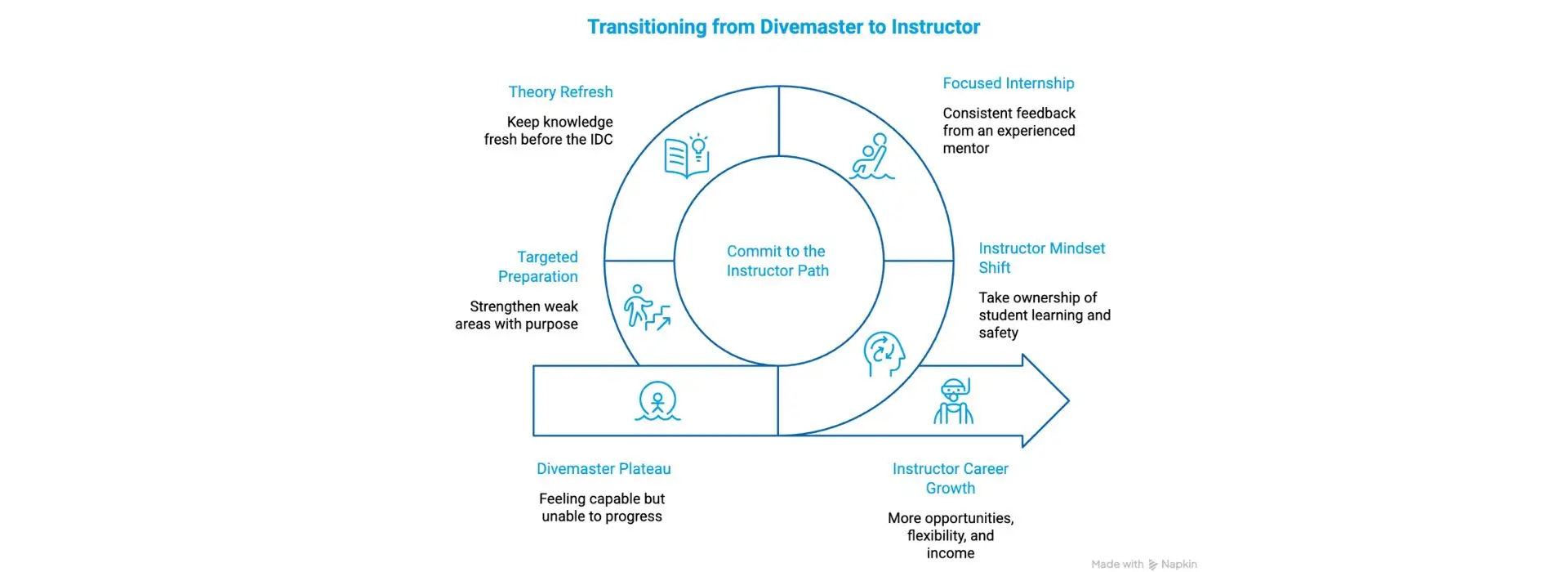
Divemaster was never designed to be the final destination. It exists to expose you to real-world diving operations, student behavior, and instructional decision-making. When you stay too long without a clear plan, frustration builds. You are ready for more responsibility, but your role limits your impact. That tension is often the first sign that your dive career progression is calling for the next step.
Is Divemaster to Instructor the natural next step?
For many professionals, the Divemaster to instructor path is not about rushing a certification, but about recognizing when responsibility and ambition have outgrown the assisting role.
In my experience, Divemaster works best as a stepping stone, not an endpoint. At this level, you sharpen awareness, professionalism, and situational judgment. You learn how instructors manage risk, structure learning, and communicate under pressure. When Divemaster becomes the end goal, growth slows, motivation drops, and confidence often erodes.
If you are unsure what really changes between these roles, I strongly recommend reading my breakdown of Divemaster versus Instructor.
Understanding that shift alone helps many candidates move forward with clarity.
What really changes when you become an instructor?
The biggest change is ownership. As an instructor, you stop assisting and start leading. You are responsible for student outcomes, safety decisions, and educational quality. That responsibility is exactly why the instructor development course feels intimidating at first. This is the point where many Divemasters begin to see the instructor role not just as a course, but as a long-term professional dive instructor career.
Here is the truth. The IDC is not designed to catch you out. It is designed to teach you how to teach. Confidence, presentation skills, and evaluation techniques are built progressively. I have trained many candidates who doubted themselves on day one and finished the course calm, capable, and confident. Readiness is not about feeling fearless. It is about being coachable.
The transition from Divemaster to instructor is less about diving skill and more about learning how to take responsibility for student outcomes, safety decisions, and educational quality.
When is the right time to start an Instructor Development Course?
There is rarely a perfect moment. Waiting for ideal conditions often turns into waiting forever. The best time to start preparing is when you feel slightly uncomfortable but genuinely excited. If you are actively assisting courses, observing instructors, and thinking about teaching, you are already closer than you think.
This perspective is also reinforced by PADI in their Pros Blog article, If you want a clear breakdown of how responsibilities and mindset change, I explain the differences in detail in my comparison of the Divemaster and Instructor roles here, which explains that the transition is less about perfection and more about preparation, mindset, and commitment to teaching.
The transition to dive instructor often feels intimidating only because it is framed as a leap, when in reality it is a structured progression.
If you want clarity on how an IDC is structured and what is actually expected, explore the PADI IDC program.
Should you wait 6 to 12 months before becoming an instructor?
One of the most common things I hear from Divemasters is that they should wait six months to one year before starting the Instructor Development Course. The reasoning is almost always the same. They want more experience guiding divers before they start teaching.
Based on my experience training dive professionals, this is usually not a good call.
In most cases, the smartest path is one to two months of a focused internship and then moving directly into the instructor course. Waiting too long often slows progress instead of improving it.
There are two main reasons for this.
1. Lack of structured feedback slows your growth
In about 99 percent of cases, Divemasters working in the field receive very little structured feedback from instructors. The common approach is “you will learn from your own mistakes.” While that sounds romantic, it often leads to frustration and a much longer learning curve.
A good internship is different. You receive constant feedback from a mentor who observes you, corrects you, and explains why certain decisions work better than others. This accelerates learning dramatically and builds real confidence, not just time in the water.
Time alone does not equal quality experience. Guided feedback does.
2. The theory problem gets harder, not easier, with time
More than 90 percent of Divemaster candidates tell me the same thing. Theory is the hardest part of the course. Physics, physiology, decompression theory, and tools like the RDP are not intuitive for everyone, and they require repetition.
Now imagine this. You finish your Divemaster course, then spend a full year only guiding dives. During that time, most of the theory fades. When you finally decide to do the IDC, you have to relearn almost everything from scratch.
If instead you move into the Instructor Development Course after one or two months of internship, the theory is still fresh in your mind. That makes the IDC significantly easier and allows you to focus on what really matters during the course, learning how to teach, evaluate, and lead students effectively.
How do you prepare with confidence instead of fear?
Preparation is not about pressure. It is about direction. Identify where you feel weakest, theory, demonstrations, or briefings, and work on them gradually. Spend time with instructors who challenge you, not just reassure you. Ask questions. Observe different teaching styles. Most importantly, stop measuring yourself against imagined standards.
Many candidates benefit from revisiting their Divemaster foundation and reframing it as preparation, not a limitation. If you want to see how Divemaster fits into the professional pathway, this overview helps reset expectations: https://idcevolution.com/courses/padi-divemaster-course-roatan/
From hesitation to action
Every dive professional I respect reached a moment where they had to choose between staying comfortable and moving forward. Staying a Divemaster can feel safe, but growth rarely lives there. Becoming an instructor opens doors, greater career flexibility, stronger income potential, and the ability to genuinely shape new divers.
If this post resonates with you, I invite you to reflect on what is truly holding you back. Doubt is normal. Avoidance is optional. If you have questions, concerns, or want honest guidance based on your experience and goals, talk about it.
When divers finally commit to the move from Divemaster to instructor, they often realize that the instructor career after Divemaster is far more achievable than they imagined.
From Divemaster to Instructor: Ready to Move Forward?
1. Why do most Divemasters feel “stuck,” according to the article?
2. How should the Divemaster role ideally be viewed?
3. What is the biggest change when you become an instructor?
4. When is the best time to start an Instructor Development Course (IDC)?
5. What mindset best prepares you for success in the IDC?
From Divemaster to Instructor, Make the Move With Confidence
You do not need more time guessing. You need the right guidance, feedback, and a clear roadmap to take the next professional step.
Plan My Instructor Journey
Add a Comment