What is the PADI career path from Open Water to instructor?
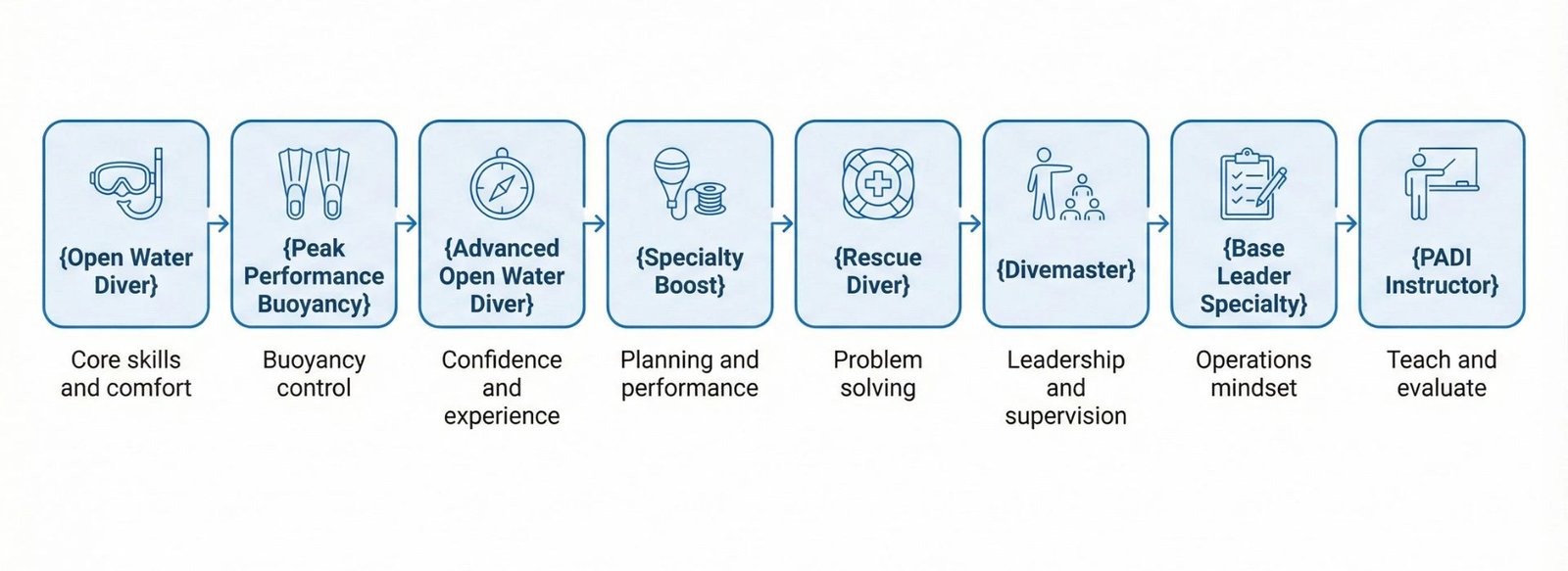
Think of the path in four phases. First you build personal diving skills. Then you build experience and consistency. Next you step into leadership. Finally you learn how to teach and evaluate. This is the heart of a solid scuba instructor roadmap, and it is also the simplest way to understand what it really takes to become a PADI instructor.
When you look at it this way, the big goal feels less like a leap, and more like a logical progression.
How should you think about Open Water and early experience?
Open Water Diver is where you learn safe foundations, basic buoyancy habits, and comfort in the water. However, your real growth comes from repetition and calm control. I always tell divers, do not rush the next card if your core skills still require a lot of mental effort.
If your long term plan is a PADI instructor career, this early phase matters more than people expect. The better your basic control becomes now, the easier every later stage becomes, especially when stress is added through task loading and responsibility.
How do you build continuity on the PADI career path after Open Water?
After Open Water, divers often ask, “What course should I take next?” The better question is, “What skill gap do I need to close next?” That is training continuity in practice.
You want dives that reinforce buoyancy, trim, navigation basics, air management, and comfort in varied conditions. If you treat this phase as structured practice instead of random dives, your dive professional training later will feel smoother and far less overwhelming.
For a clear overview of how divers typically progress from beginner to professional, this is a useful reference: https://blog.padi.com/beginner-to-pro.
What changes when you start dive professional training at Divemaster?
Divemaster is where the shift becomes real. You move from focusing on your own dive to managing awareness for the whole team. In the real world of dive operations, that means you learn to anticipate problems before they happen, communicate clearly, and support instructors while keeping standards and safety in mind.
This stage is a major step in the PADI career path because it develops professional habits. You are building leadership, judgement, and responsibility, not just personal ability.
If you want a quick comparison of what the role looks like, this page supports the decision well: Divemaster vs dive instructor.
If you are ready to explore the training details, this is the track I run in Roatán: PADI Divemaster course.
Which specialties strengthen your scuba instructor roadmap?
- PPB (Peak Performance Buoyancy), sharper trim and control, which makes demonstrations cleaner and reduces stress in every environment.
- Deep Diver, better gas awareness, narcosis management, and planning discipline, which strengthens judgment and supervision habits.
- Wreck Diver, stronger navigation and risk assessment, plus improved situational awareness around structure and entanglement hazards.
- Underwater Photography, improved buoyancy stability and patience, plus a better understanding of how divers behave when distracted.
- Tec Safety Diver*, stronger emergency readiness, team protocols, and support skills, which builds calm competence under pressure.
- Sales for PADI Pros*, better communication, needs analysis, and ethical selling, which helps you build a sustainable career, not just collect certifications.
- Base Leader Specialty*, stronger leadership at the dive center level, smoother coordination with staff, better decision making, and a more professional mindset on the job.
* Note: Tec Safety Diver, Sales for PADI Pros, and Base Leader Specialty are PADI Distinctive Specialty courses developed by me, built from real dive shop operations and the exact skills I see dive pros need most in the field.
Why is the IDC the milestone to become a PADI instructor?
The IDC is not just another step, it is the moment your role changes. You stop training only for yourself, and you start training to teach, evaluate, and adapt for others. That is why the IDC is the true professional milestone in the PADI career path.
During the IDC, communication becomes as important as buoyancy. Planning becomes as critical as execution. You develop the ability to manage groups, deliver knowledge clearly, and maintain safety standards consistently across different conditions. This is the stage where divers stop thinking like participants and start thinking like leaders.
If you want to see how we frame that transition, here is our PADI IDC page.
For another high level look at the pro pathway, this article is a helpful overview: https://www.scubadiving.com/path-padi-pro.
How do you keep the PADI career path smooth and avoid setbacks?
The biggest mistake I see is rushing. Speed can work, but only if skill mastery stays ahead of the schedule. The best candidates treat the journey as a system, and they build consolidation time between steps.
Dive between courses. Assist when possible. Watch instructors closely. Practice briefings. Repeat demonstrations until they look calm and effortless. This approach creates real training continuity, and it protects your confidence when the pressure rises.
Before the final step, I would love to hear your experience. Where are you right now in the PADI career path, and what feels like the hardest part of the next move?
Ready to map your path to instructor?
If your goal is to become a PADI instructor, treat the journey like a roadmap, not a collection of cards. Build strong fundamentals, step into leadership intentionally, choose specialties strategically, then make the IDC your milestone.
If you want, I will build you a personalized training plan. What is your current certification level, how many logged dives do you have, and what timeline are you aiming for?
Are You Ready for the PADI IDC?
1. What matters most during confined water skill demonstrations in the IDC?
2. How should the PADI career path be viewed?
3. What is the biggest shift when you begin Divemaster training?
4. Why is the IDC considered the true professional milestone?
5. What is the best way to avoid setbacks on the PADI career path?